Khronos Releases OpenGL 3.3 & OpenGL 4.0
Posted by Michael Larabel on March 11, 2010

The Khronos Group has been updating the OpenGL 3.x spec about every six months and with OpenGL 3.2 having been released last August, we expected OpenGL 3.3 would be announced soon and figured it may come this week during the Game Developers' Conference in San Francisco. Well, it did. Not only did Khronos releases the OpenGL 3.3 specification, but they have also went ahead and already released OpenGL 4.0!

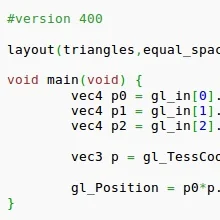
The OpenGL 4.0 release took us by surprise and this spec is also tied to the GLSL 4.00 update for the GL Shading Language. OpenGL 4.0 continues to offer compatibility with older OpenGL extensions and ways using the compatibility profile mode introduced in OpenGL 3.2 while the core profile is also still in place. OpenGL 4.0 expands upon the integration with OpenCL (Open Computing Language), provides two new shader stages for geometry tessellation work, per-sample fragment shaders and programmable fragment shader input positions, drawing of data generated without CPU intervention, support for shader subroutines, separation of texture state and texture data, 64-bit double precision floating point shader operations, and many performance improvements.

The OpenGL 4.0 specification (along with the OpenGL 3.3 spec) is available for immediate download at OpenGL.org. The OpenGL 3.3 specification is designed to bring as much of the new OpenGL 4.0 functionality back into OpenGL 3.x as possible while still retaining compatibility with existing graphics processors. The press release announcing OpenGL 4.0 and 3.3 can be read via the Khronos Group.

It's expected that NVIDIA soon will release a proprietary driver update enabling OpenGL 3.3/4.0 support for Linux. We have not heard any comments from ATI/AMD on when they plan to introduce OpenGL 4.0 functionality, but it will likely be a few months. Lastly, while it's terrific that the OpenGL specification is evolving at a steadfast rate, the open-source OpenGL acceleration support via Mesa and Gallium3D is not. We still do not have any reliable OpenGL 3.x support in any open-source Linux graphics driver and have yet to see the OpenGL 3.2 state tracker surface. The open-source support is now yet another step behind the latest Khronos spec and somehow needs to get caught up with this quickly evolving graphics API.

Discuss this article in our forums, IRC channel, or email the author. You can also follow our content via RSS and on social networks like Facebook, Identi.ca, and Twitter (@Phoronix and @MichaelLarabel). Subscribe to Phoronix Premium to view our content without advertisements, view entire articles on a single page, and experience other benefits.
Latest Hardware Reviews
  1. Intel Haswell HD Graphics 4600 vs. AMD Radeon Graphics On Linux
  2. Intel Haswell HD Graphics 4600 Performance On Ubuntu Linux
  3. Intel Core i7 4770K "Haswell" Benchmarks On Ubuntu Linux
  4. The First Experience Of Intel Haswell On Linux
Latest Software Articles
  1. Optimized Binaries Provide Great Benefits For Intel Haswell
  2. 11-Way Linux, BSD Platform Comparison
  3. SNA Acceleration Works Great For Intel Core i7 Haswell
  4. The Linux Evolution For Intel Haswell's Performance
Latest Linux News
  1. KDE's KWin Made Lots Of Progress In 4.11
  2. Ubuntu Announces Carrier Advisory Group
  3. Qt 5.1 Release Candidate 1 Has Arrived
  4. In-Fighting Continues Over Mir On Non-Unity Ubuntu
  5. Subversion 1.8 Presents New Features
  6. LLVM 3.3 Officially Released
  7. LLVM/Clang Now Uses Loop Vectorizer At New Levels
  8. Intel GPU Driver Tries To Rip Out FBDEV Support
  9. Coreboot Doing AMD USB 3.0, Q35 QEMU Emulation
  10. VP9 Codec Now Enabled By Default In Chrome
  11. openSUSE 13.1 M2 Plays On PulseAudio 4.0
Latest Forum Talk
  1. In-Fighting Continues Over Mir On Non-Unity Ubuntu
  2. Ubuntu Announces Carrier Advisory Group
  3. VP9 Codec Now Enabled By Default In Chrome
  4. Intel GPU Driver Tries To Rip Out FBDEV Support
  5. Handbrake 0.9.9 Supports OpenCL Offloading
  6. Planetary Annihilation Plans To Come To Linux
  1. Computers
  2. Display Drivers
  3. Graphics Cards
  4. Motherboards
  5. Peripherals
  6. Processors
  7. Software
  8. Operating Systems
  9. All Articles
  1. Linux Benchmarking
  2. OpenBenchmarking.org
  3. Phoronix Test Suite